TL;DR
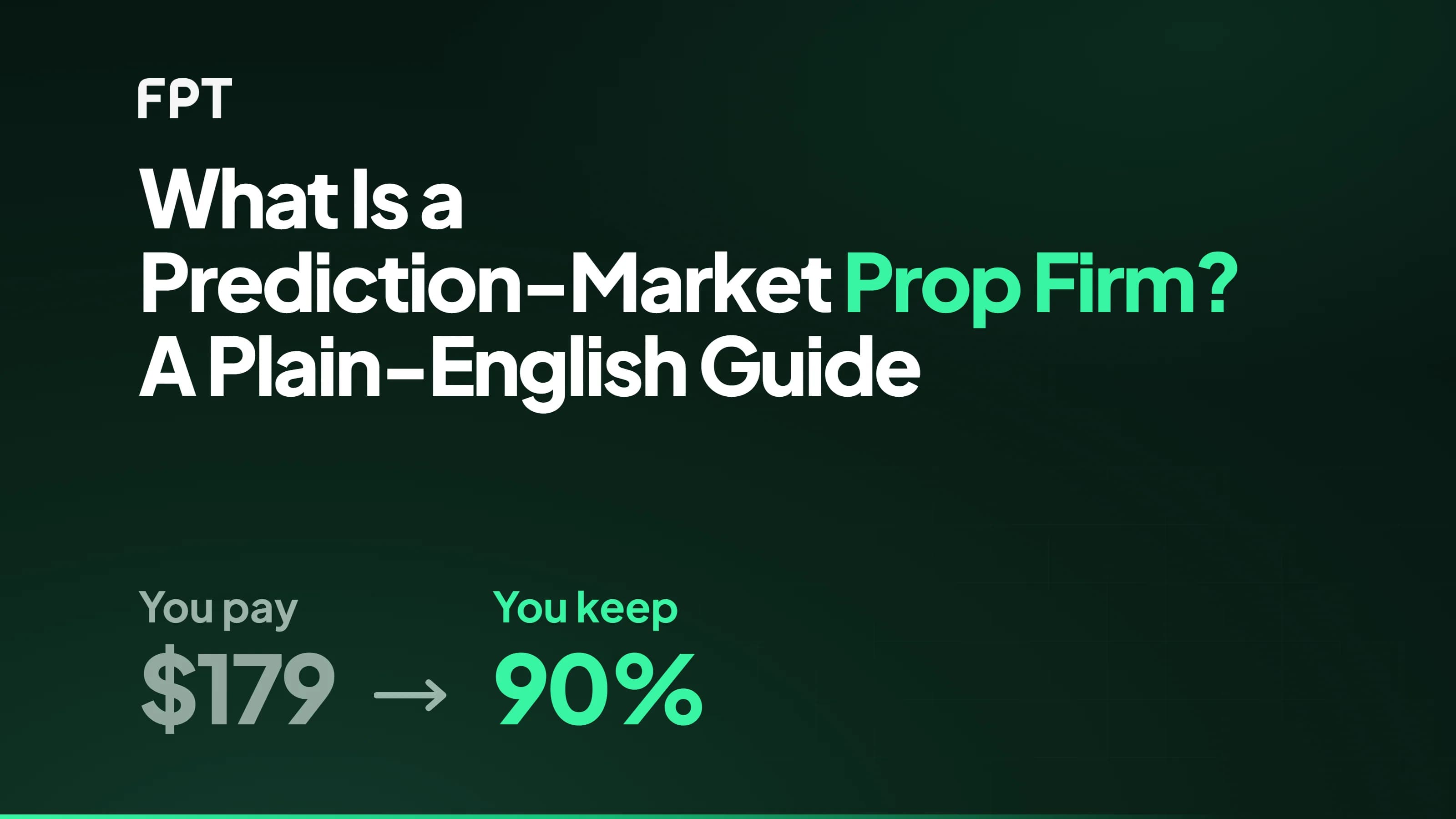
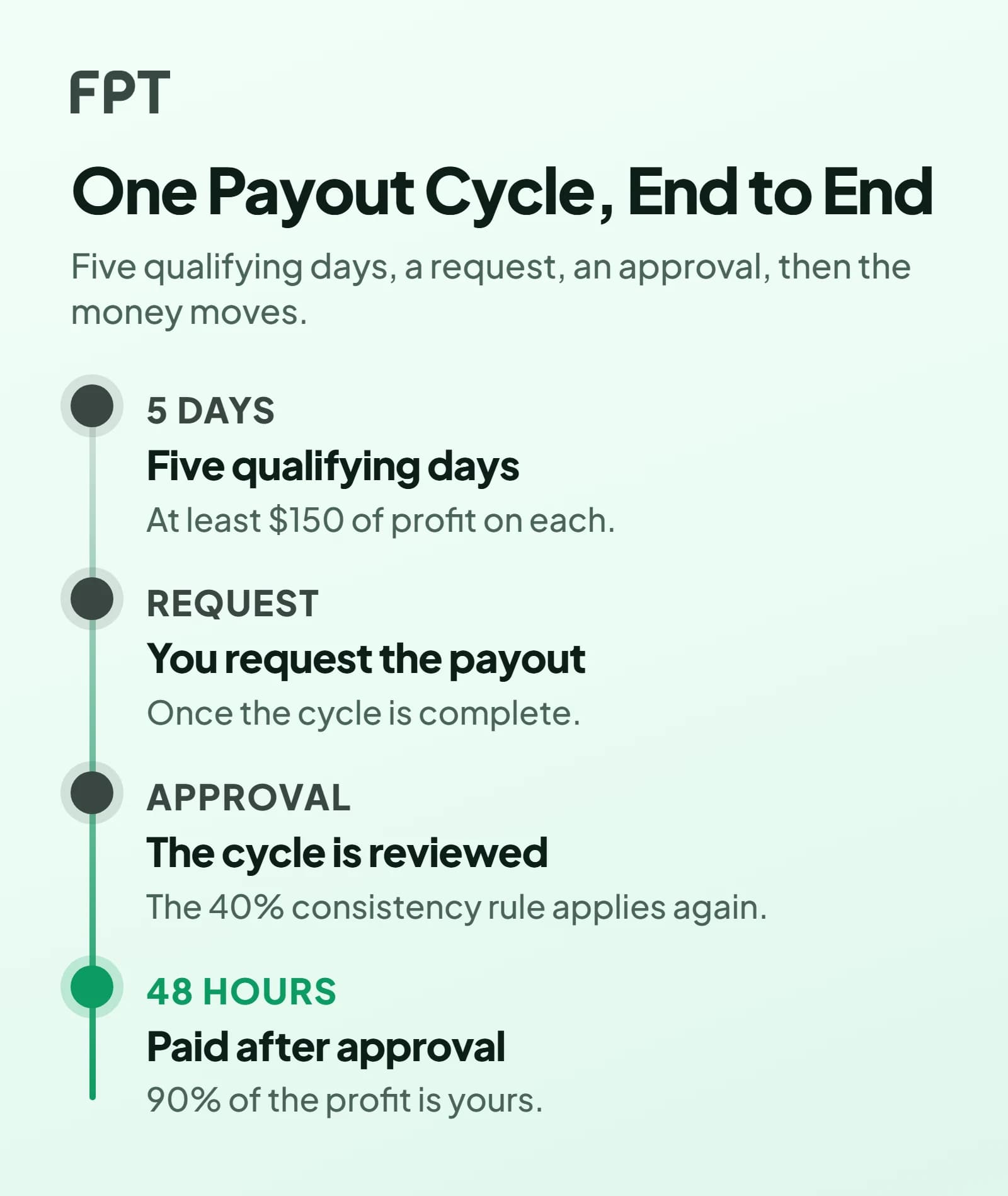
Funded Prediction Trader applies the prop-firm model to prediction markets. Pass a one-step FPT Scale evaluation on a simulated trading account, then trade event contracts on Polymarket and Kalshi under published rules, keep 90% of profits, with approved payouts sent within 48 hours of approval.
- $50k FPT Scale: $3,000 target, $2,000 max loss, no separate daily loss limit.
- One evaluation phase, five profitable days to pass (each clearing $150 on the $50k), 90% of profits yours from payout one.
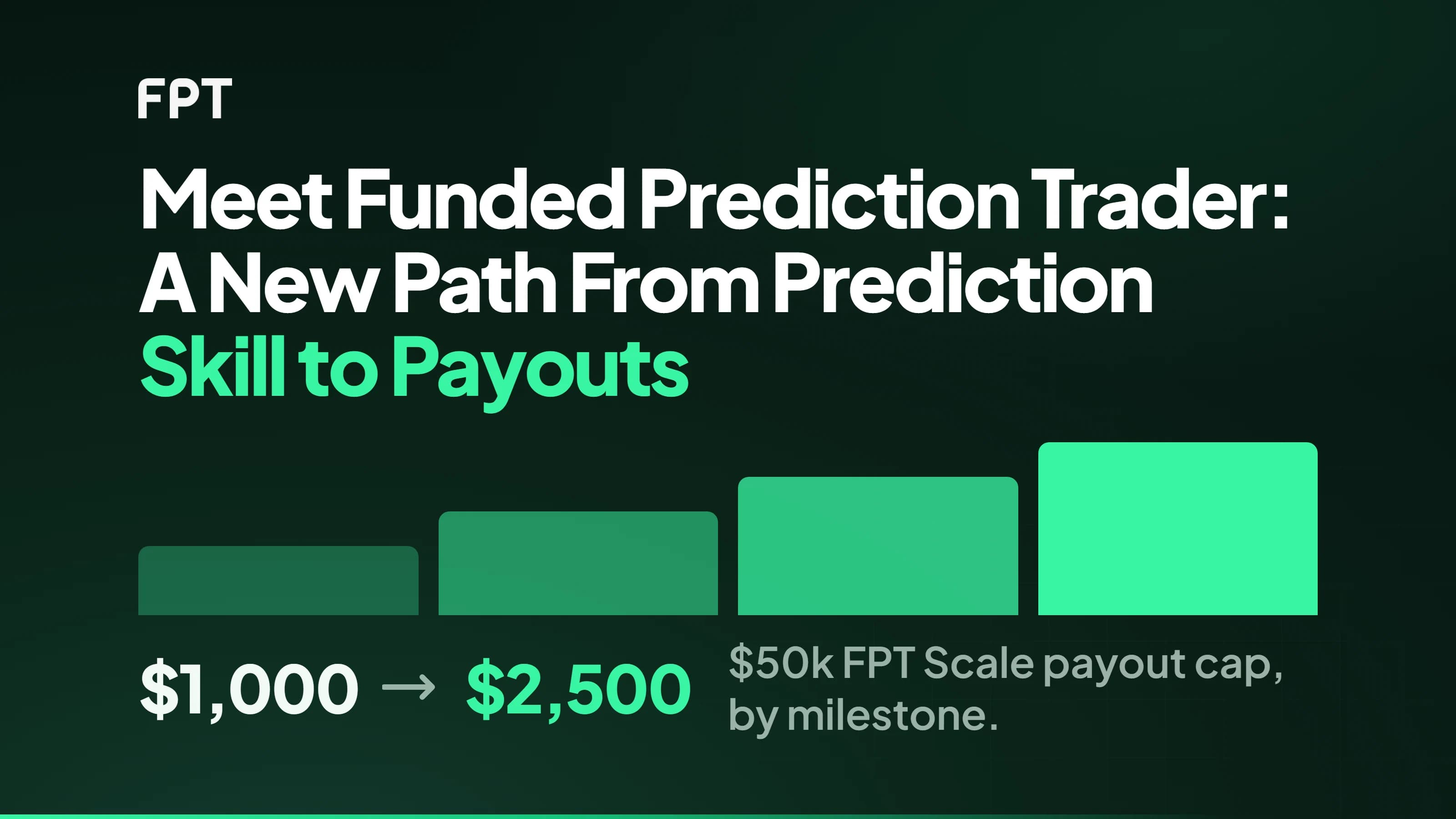
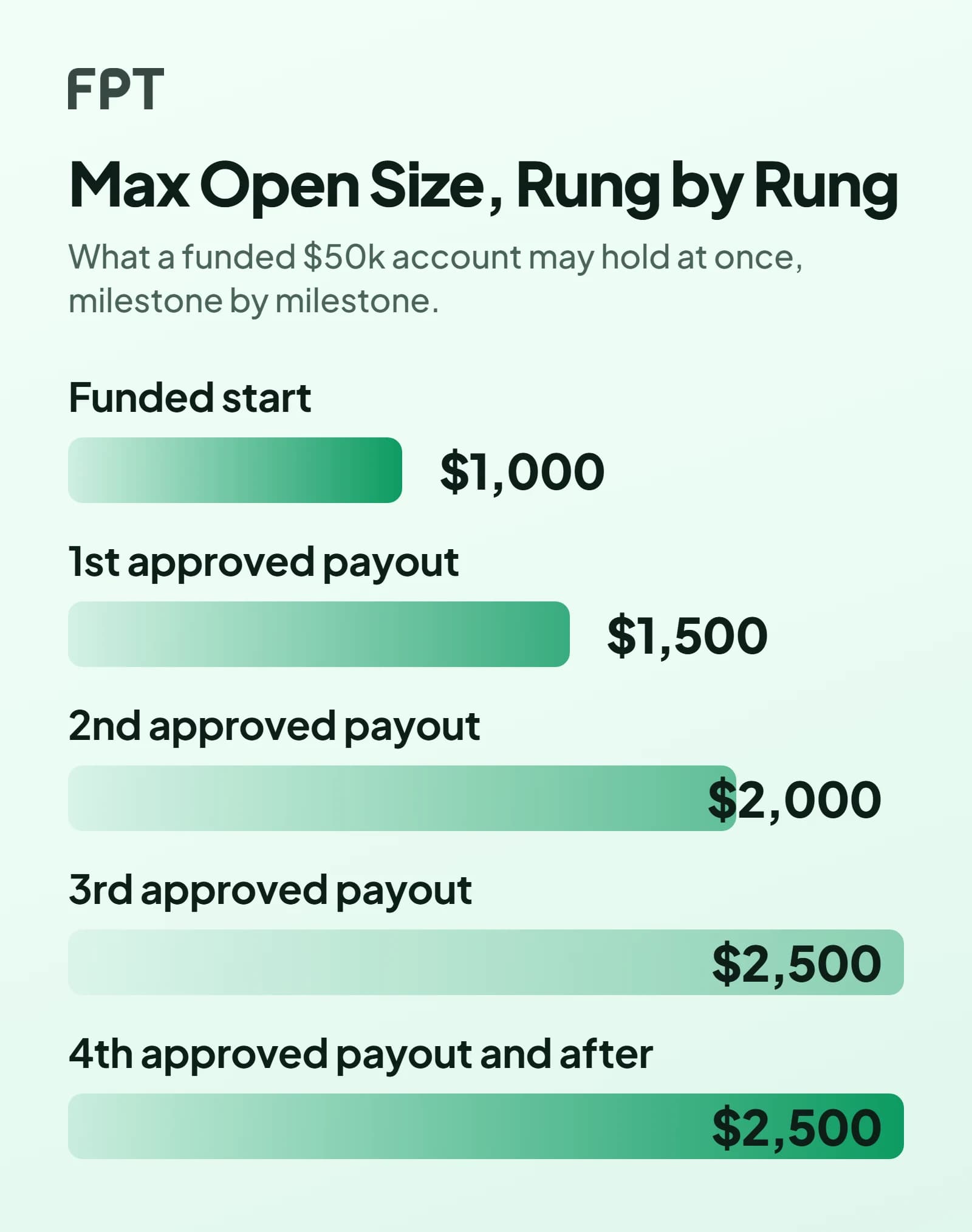
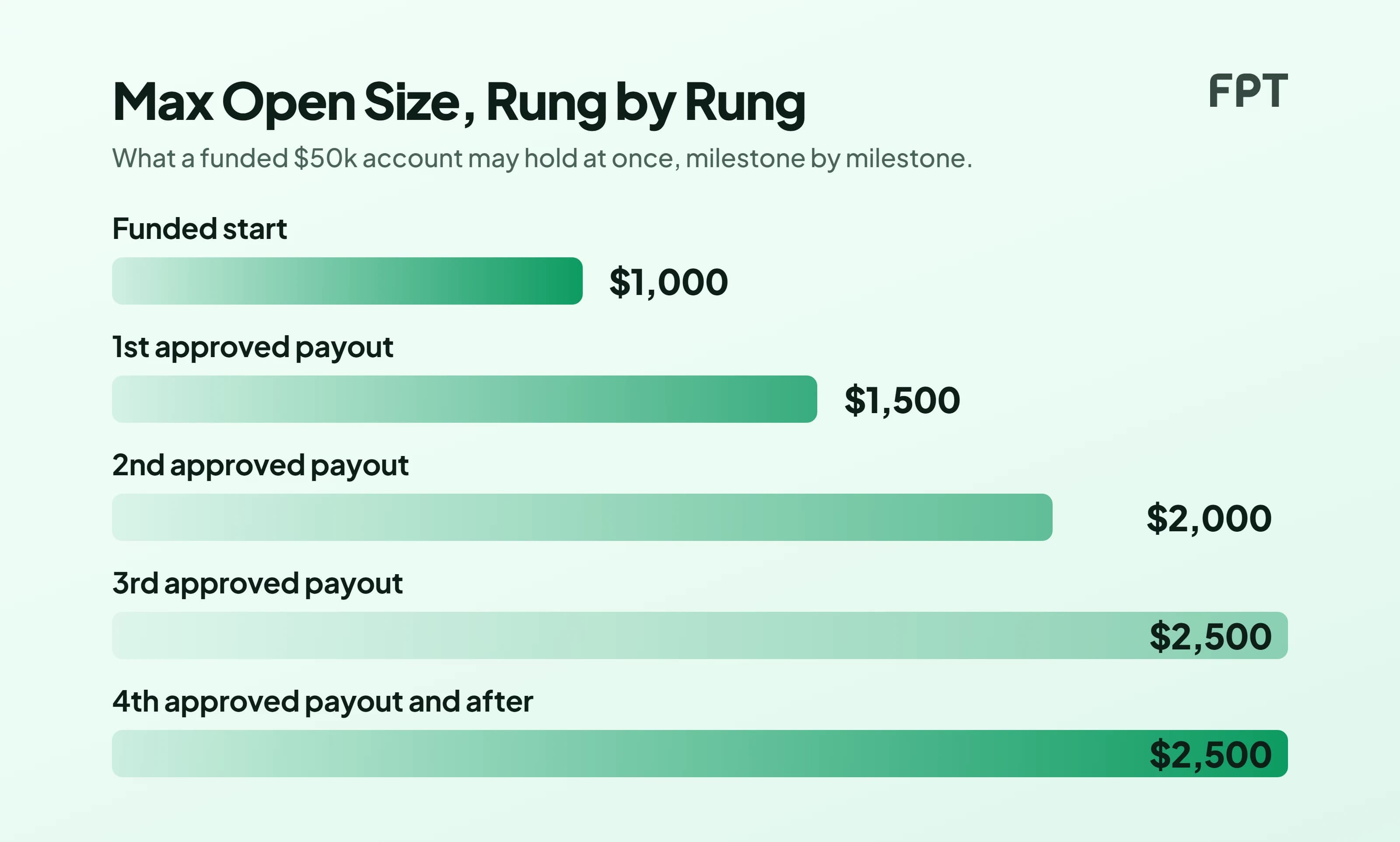
- Approved payouts raise the cap and max open size, $1,000 to $2,500.
- $50k founding price $179 with the code FOUNDER, against $249 regular.
A trader who prices a Fed decision better than the market earns in proportion to the money already in their account. Skill compounds. The account under it does not. That gap is why we started this company.
You have probably felt it. A read lands, the position is capped by what you happened to have on hand at the start of the year, and a good call pays like a small one. So you scale down, take fewer shots, and the edge you actually have never gets tested at size.
FPT Scale is our answer. One evaluation on a simulated trading account, then a funded account with published rules, a 90% profit split, and payout caps that rise as approved payouts stack up.
The Gap That Started It
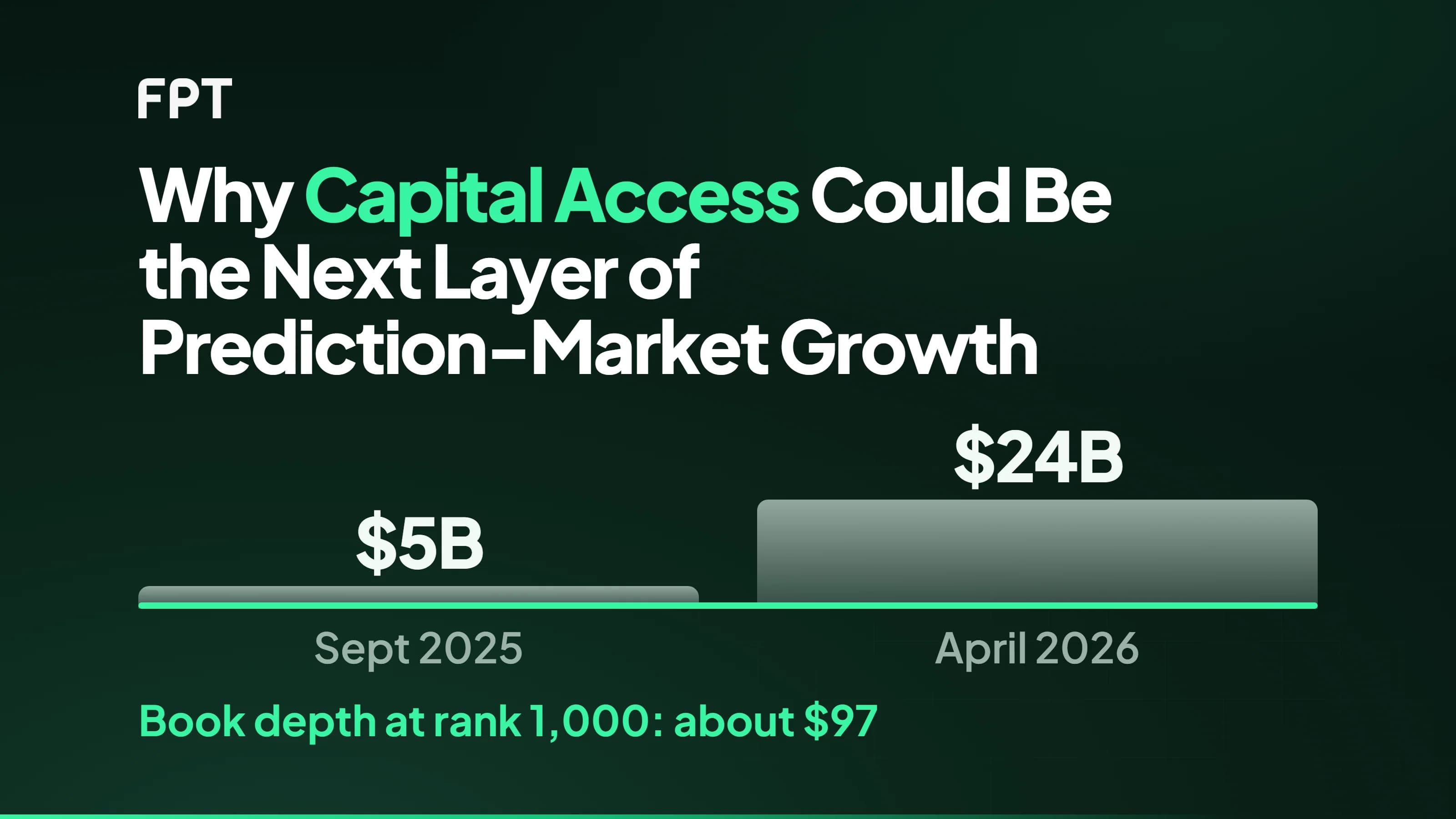
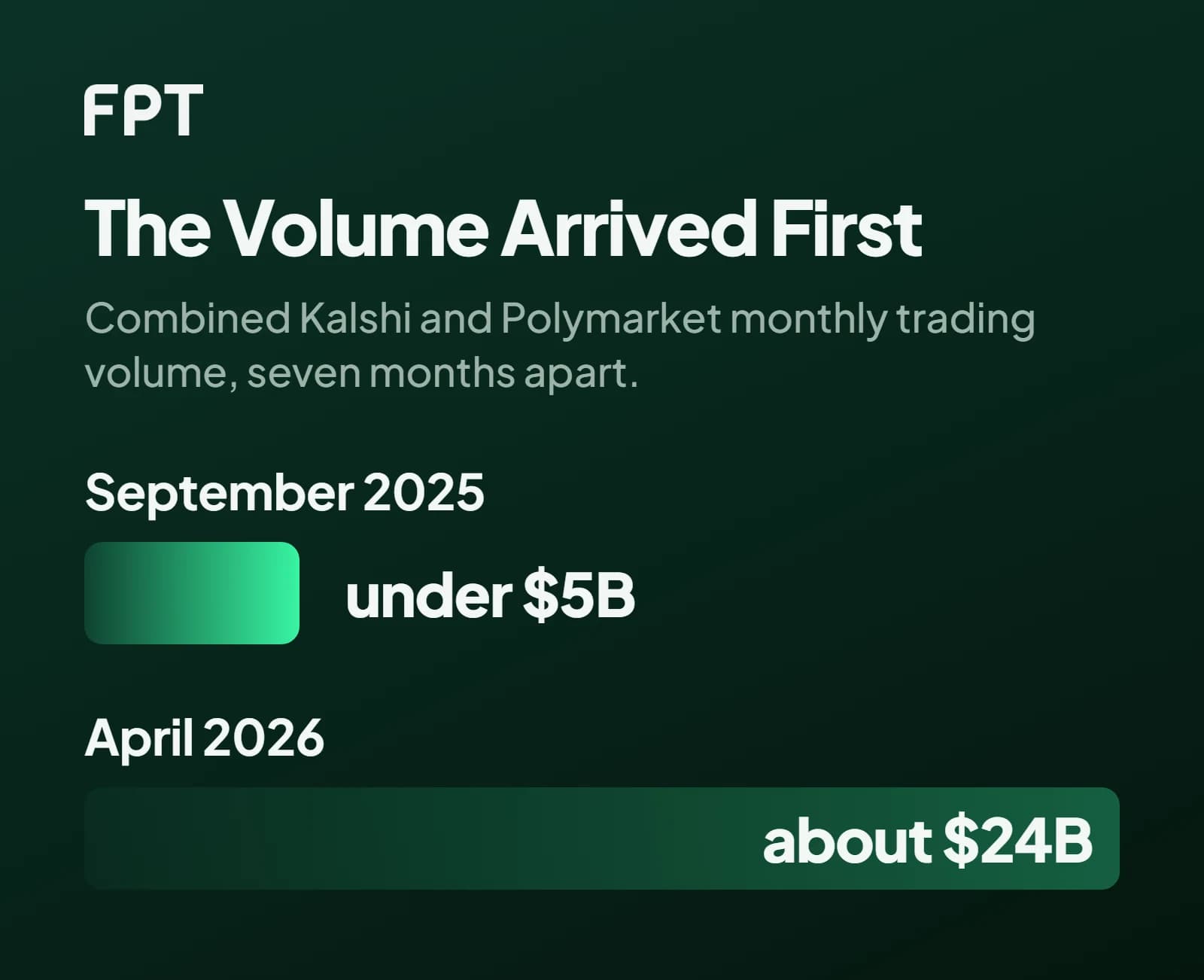
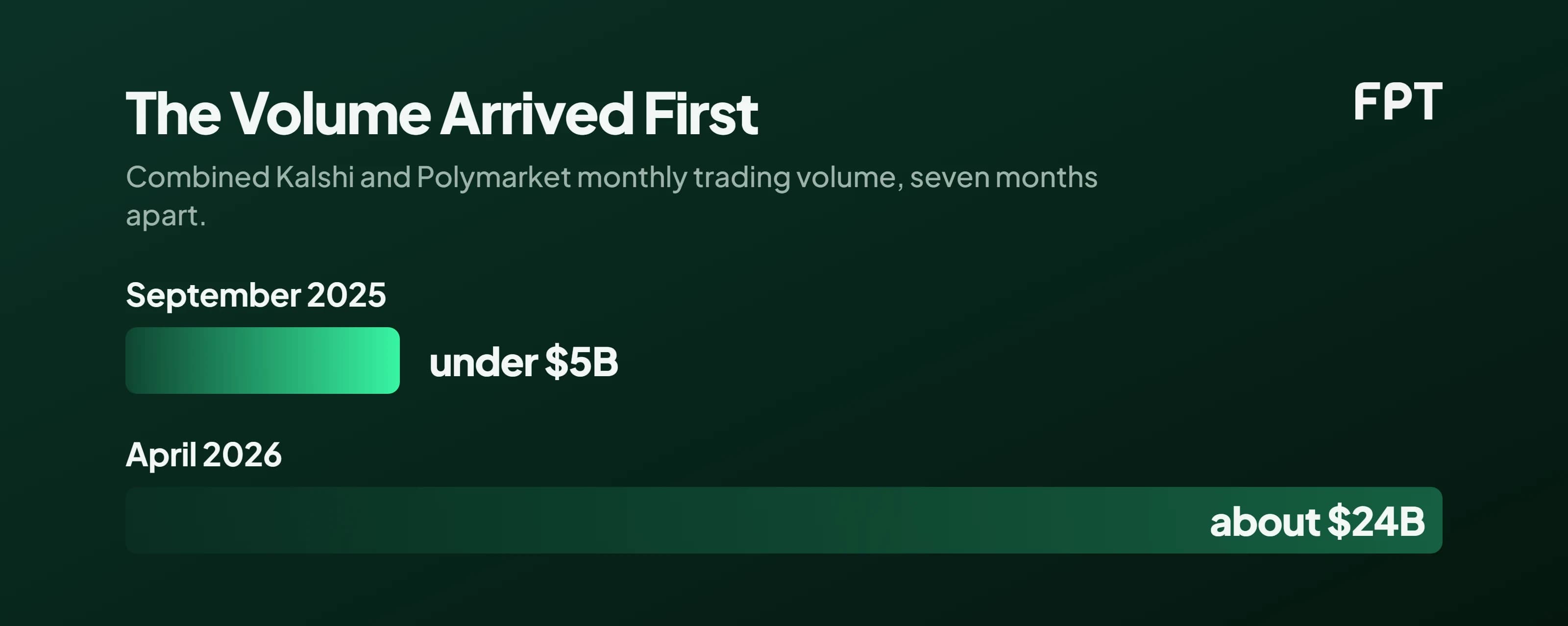
Prediction markets got big in a hurry. Combined monthly volume across Kalshi and Polymarket climbed from under $5 billion in September 2025 to about $24 billion in April 2026, on Pew Research Center's reading of data from The Block. Both sit on the CFTC register of designated contract markets, Polymarket through its US entity.
Volume is not access. A deeper market gives you more to be right about, not a bigger account. Being right and being able to size are different problems. Nobody was solving the second. New here? Start with what a prediction-market prop firm is.
What Traders Do Instead
Two workarounds exist. Both charge you something. Trade your own account and you answer to nobody, but the ceiling is your balance rather than your read. Buy a futures evaluation and the funded structure is pointed at the wrong instruments: what you actually price is crude or EURUSD, not event contracts. One long-running program describes its own accounts as demo accounts with fictitious funds.
Three routes to a bigger position
Trade Your Own Account
- Full profit, no rulebook.
- The ceiling is your own balance.
Buy a Futures Evaluation
- Demo accounts, fictitious funds.
- Crude and EURUSD, not events.
Pass an FPT Scale Evaluation
- Built for event contracts.
- Limits set in dollars.
- 90% to you from payout one.
That is why FPT is a separate product. Polymarket's help center says the counterparty to each trade is another Polymarket user, so no dealer is quoting you a size to count.
How FPT Scale Works
The product is four moves, and none of them sit behind a sales call. Pass one evaluation, trade funded, receive approved payouts within 48 hours of approval, then unlock more size.
What Account Size Actually Means
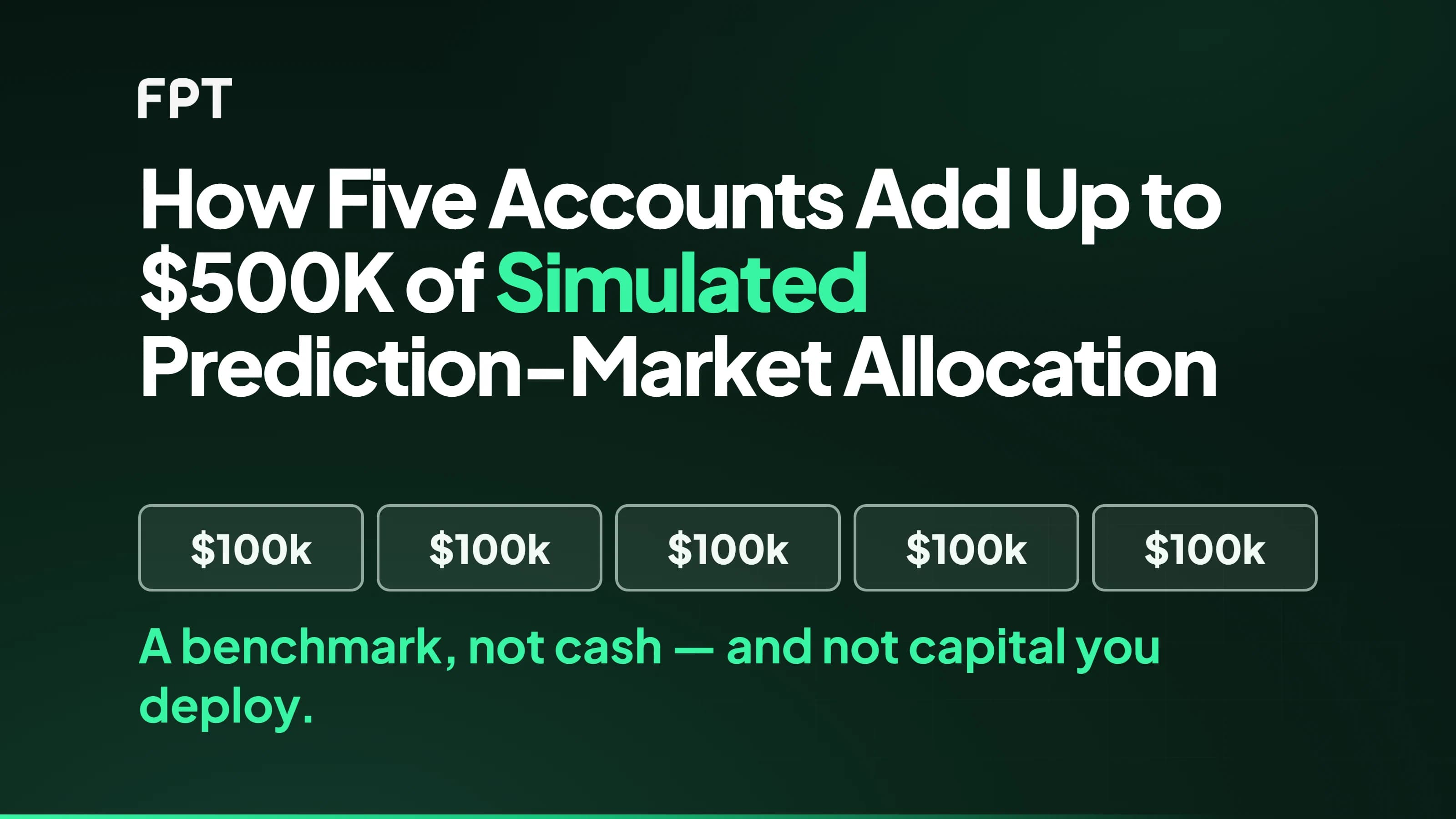
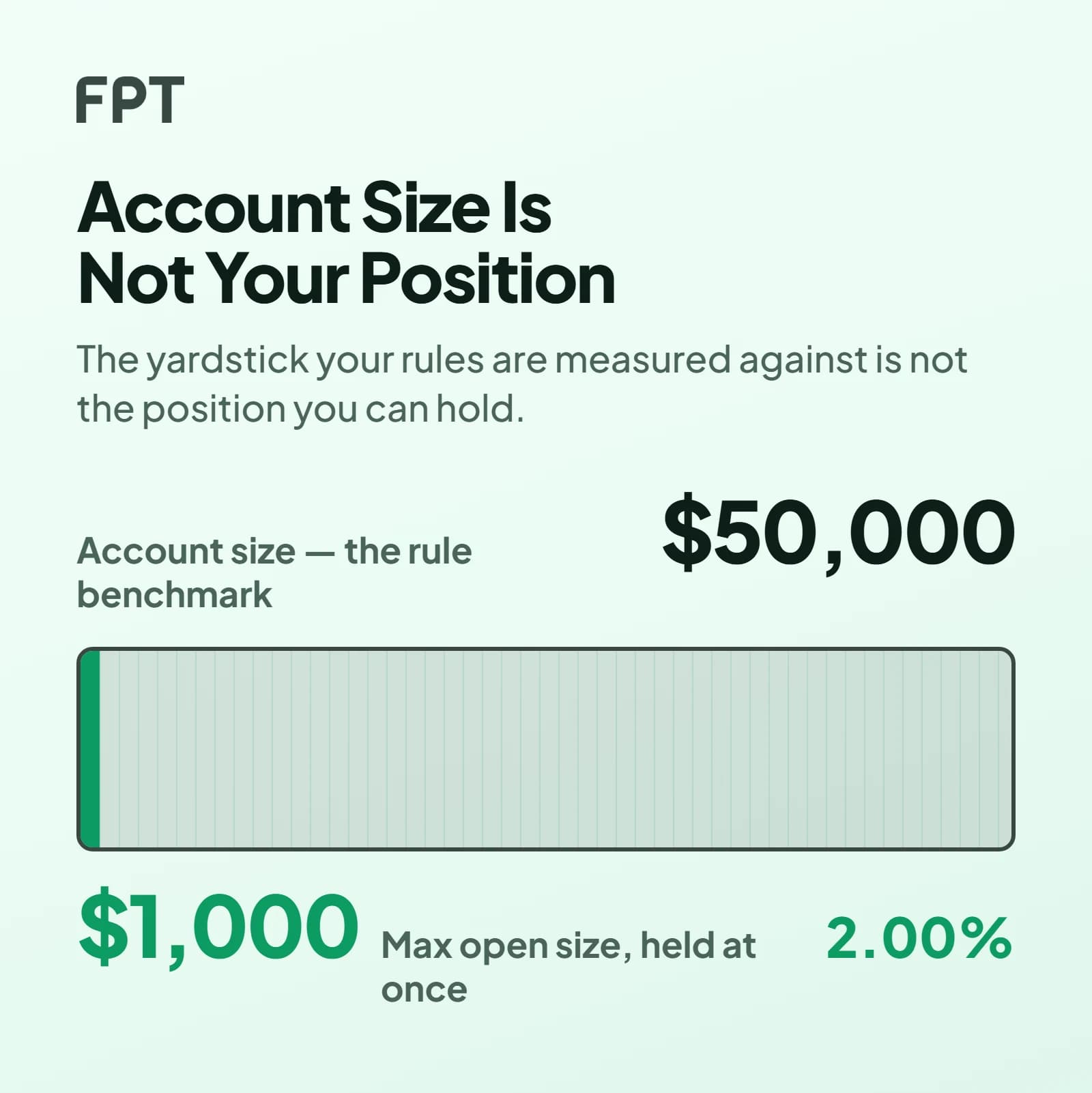
Account size is the benchmark your profit target, max loss and drawdown are measured against. It is not cash paid to you and not buying power. What you can hold at any moment is your max open size: $1,000 on a funded $50k account at funded start, rising to $2,500 at the top rung.
How Big a Position You Can Actually Take
Suppose your best market is a quiet one. Your account's max open size says one thing, and the market's own depth says another. The smaller of the two wins, every time.
Worked example
Sizing the Same Trade in Two Books
- Funded account
- $50k FPT Scale
- Max open size
- $1,000
- Market limit
- 5% of 24h volume
Size with the book in front of you, and the account limit is rarely the one you meet first.
Why We Designed the Rules This Way
Three rules took the longest to settle, because each one shapes how a trader actually works here. This is the reasoning behind them.
No Separate Daily Loss Limit
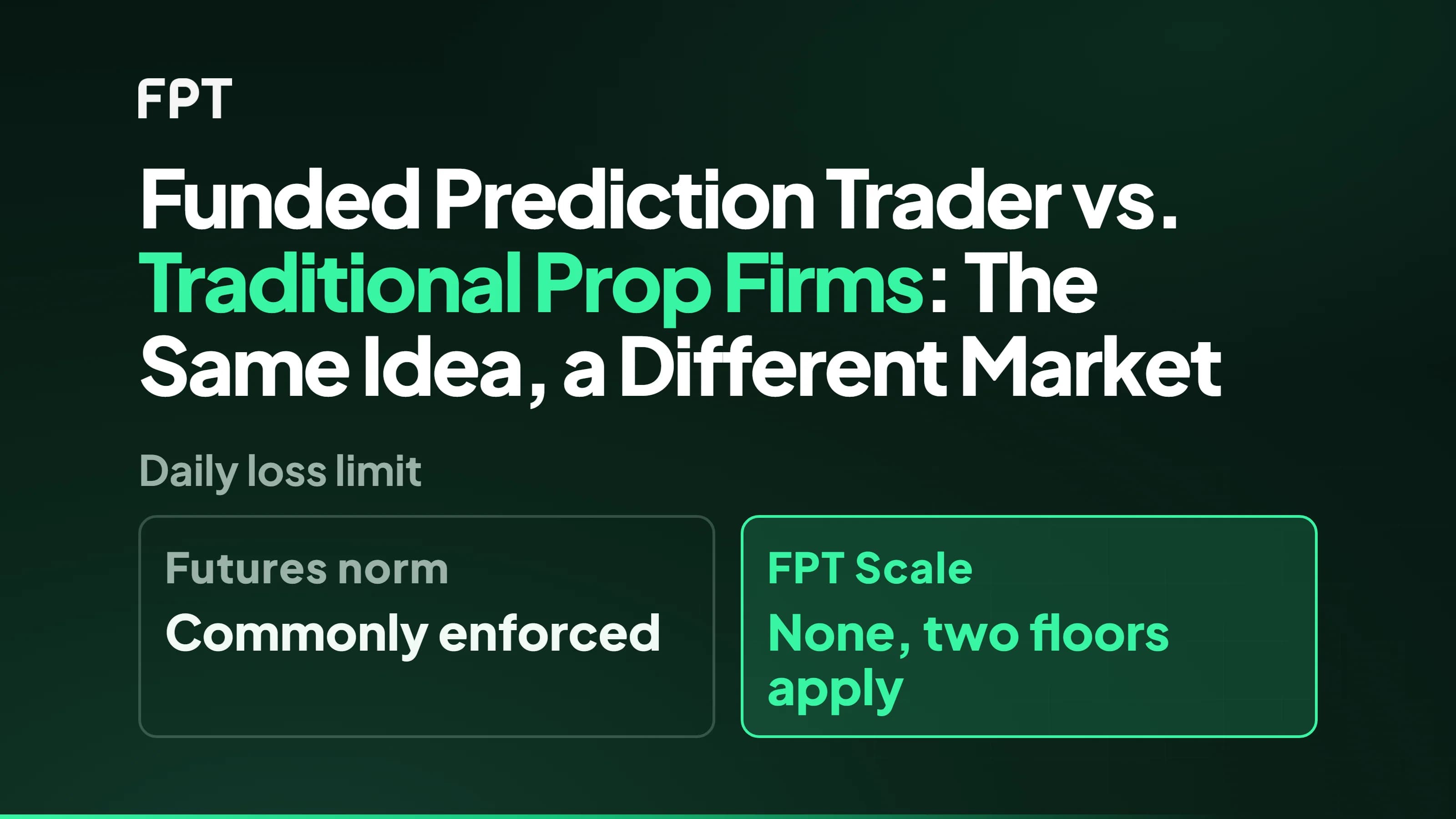
Prop traders react to this one first. We took away a circuit breaker, not a risk: max loss and end-of-day trailing drawdown both still apply. An event contract can reprice at 3am, with no session close to be flat by.
How the Consistency Rule Works Once You Are Funded
The 40% consistency rule applies to funded payout cycles, not just the evaluation, and going over it is not a breach — it defers a payout until further profitable days bring the ratio down. It is there so the ladder rewards a repeatable edge rather than one lucky resolution, which is what makes the scaling tiers worth climbing.
The Market Volume Cap
Any one market is capped at 5% of its 24-hour volume, and an order over the line is blocked rather than counted against you. Futures rulebooks cap contracts or lots. None we read caps you against the market itself. In a thin book that is the tighter limit, better published than found in a bad fill. Rule by rule against the futures norm goes further.
Who Gets the Most From FPT Scale
The traders who do best here already have a read they can repeat. What they are missing is the account behind it, which is the part we built.
You will get the most from FPT Scale if
- You trade a read you can repeat, often enough to build five profitable days.
- Your markets carry enough daily volume to support the size you want.
- You are comfortable working inside a published rule set on a simulated account.
- You would rather prove a repeatable read under published rules than grow your own balance to get size.
Two shapes fit it less well, and they are worth knowing before you buy. An edge that resolves in four big events a year runs into the consistency rule, and an edge that only exists in books turning over a few thousand a day runs into the 5% market cap. New to the instrument? Start with prediction markets against sportsbooks.
Building FPT Before Public Launch
FPT is pre-launch, so nothing has been sold and there is no performance history to read. What is already published is the part you buy: the full rule set, the pricing, the payout ladder and the account mechanics, all published before you pay. When approved payouts exist, we publish the numbers and the method behind them.
Account size is the yardstick. The payout is the product.
The Founding Window
Founding pricing goes to the first 100 eligible completed purchases after checkout opens: $179 on the $50k FPT Scale with code FOUNDER against $249 regular, an undiscounted $99/mo monthly plan, and a $99 reset. No payment is taken before then, and checkout opens once our platform and payment infrastructure are production-ready. Buying cannot bring that date forward; opening the checkout is what starts the count.
Two rules are worth reading closely before you start, because between them they set the pace of a run: the end-of-day trailing drawdown and the 40% consistency rule. Both are written out in the rules and FAQ, in full, before you pay anything. Then pick your account size and buy at the founding price once checkout opens.
Sources & Method
Written by the FPT editorial desk. Every product number is checked line by line against FPT's published offer configuration and the approved FPT Scale offer spec; category and venue facts are sourced to pages opened on the access date and attributed inline.
- Trading volume on prediction markets has soared in recent months — Pew Research Center, May 27, 2026. Accessed Jul 26, 2026.
- Designated Contract Markets (DCM) — Commodity Futures Trading Commission. Accessed Jul 26, 2026.
- Understanding Prediction Markets and Event Contracts — Commodity Futures Trading Commission. Accessed Jul 26, 2026.
- How is Kalshi regulated? — Kalshi, Mar 19, 2026. Accessed Jul 26, 2026.
- What is Polymarket? — Polymarket, May 2, 2026. Accessed Jul 26, 2026.
- Trading Objectives — FTMO. Accessed Jul 26, 2026.
Common Questions
Is an FPT Scale account real money?
The account is simulated and the payouts are real. FPT Scale accounts are simulated trading accounts, and the account size is the benchmark your profit target, max loss and drawdown are measured against — not cash paid to you and not capital you deploy. Approved payouts are sent within 48 hours of approval.
What does the $179 founding price cover?
It buys the $50k FPT Scale account at $179 with code FOUNDER, against $249 regular. Founding pricing goes to the first 100 eligible completed purchases after public checkout opens.
Is FPT affiliated with Polymarket or Kalshi?
Both venues are included with every FPT Scale account, and FPT is not affiliated with, endorsed by or operated by either one. Venue availability depends on your location, exchange access and applicable restrictions.
Does FPT publish payout proof, pass rates or reviews?
Not yet, because there are no customers yet. FPT is pre-launch and publishes no payout totals, pass rates, trader counts, reviews or awards. When payout data exists, it will be published with the method behind it.
What happens if I fail the evaluation?
A one-time reset on the $50k FPT Scale account costs $99, or $59 on the monthly plan, and the monthly reset is a single charge that does not reduce your subscription price. Resets on funded accounts are not available at launch.
Referenced on this site